

Unbillable Breakfast · A Newsletter By Gittins Attorneys · Immigration Law · 4th Edition · 8 min read · 21 July 2026
THE POINTS-BASED SYSTEM UP CLOSE
How a score replaces a category and why a qualified, employed professional can still come up twenty points short
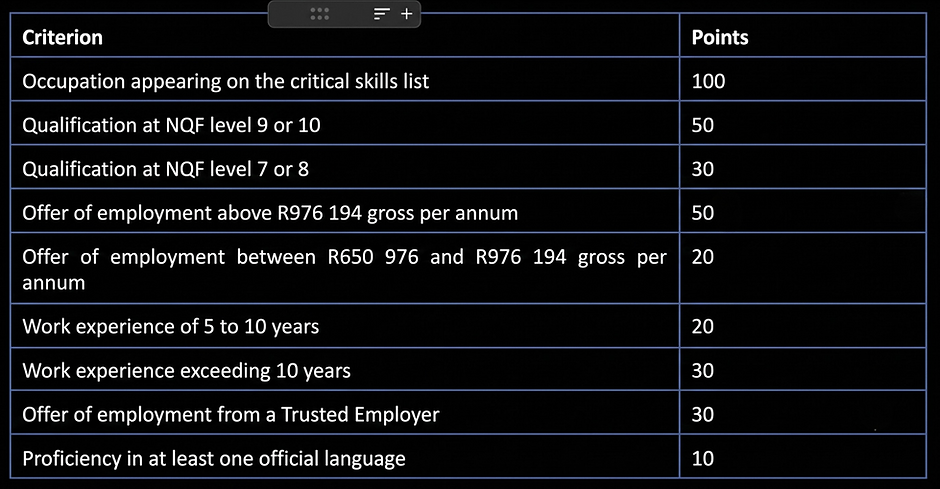
Consider someone an employer wants to hire. She holds an honours degree, has seven years' experience, speaks English, and has been offered R720 000 a year. Nothing about her is unusual. Under the rules in force today she cannot take the job. She scores 80 points, and she needs 100.
Those twenty points are the clearest way into what the Revised White Paper on Citizenship, Immigration and Refugee Protection is actually doing. The first three articles in this series dealt with the new architecture, the biometric systems being built to run it, and what compliance now costs. This one deals with the arithmetic, because under a points system the arithmetic is what decides who gets in.

THE SCORECARD IS ALREADY LAW
A points system is not coming to South Africa. Most of it arrived on 9 October 2024, when the Minister of Home Affairs gazetted the Points-Based System, 2024 (GN 5448 in Government Gazette 51416) under sections 19(2) and 19(4) of the Immigration Act 13 of 2002, read with regulations 18(12) and 18(13) of the Immigration Regulations, 2014. It governs general work visas and critical skills work visas. Intra-company transfers are untouched.
.png)
An applicant needs 100. Police clearance, medical report and the rest of the documentary requirements still apply on top of that; points buy nothing on their own.
Two doors lead off the same table. An occupation on the critical skills list scores 100 by itself, and the applicant may be issued a critical skills work visa. Reach 100 by any other combination and the visa is a general work one. Beyond that, both are now decided by the same nine lines.

WHAT THE NUMBERS REWARD
Read the table as an employer and its priorities are plain.
Salary is half the board. An offer above R976 194 scores 50 on its own. An offer below R650 976 scores nothing at all, however scarce the skill or however strong the candidate. A doctorate at R1,1 million clears the threshold on two criteria and never needs a third. A three-year degree at R480 000 with four years' experience reaches 40, and no combination on the table rescues it.
That puts the weight of the system on the sectors least able to pay. Academia, non-profit work, much of healthcare and most of the small-business economy sit below the lower band. They are not losing candidates because those candidates are unqualified. They are losing them on remuneration.
Then there is the Trusted Employer Scheme, worth 30 points, which is very often the exact size of the gap. The candidate described above gets in if her employer is accredited and does not if it is not. Nothing about her changes. Accreditation has quietly become one of the more valuable assets an employer recruiting abroad can hold.

THREE THINGS IN THE REVISED WHITE PAPER CHANGES
Cabinet approved the Revised White Paper on 3 April 2026. Three moves matter.
1. One door instead of two:
The general work visa and the critical skills work visa are to merge into a single skilled worker visa, points-assessed and open to any background. That removes the cliff edge, where an occupation today either scores 100 or scores nothing, with no middle ground. Renewal will turn on proof of continuous employment, and a failure to renew means departure at the end of the job. But renewal is also intended to carry a route to permanent residence without employer sponsorship, which loosens a grip employers presently hold over their foreign staff's status.
2. Points all the way up
Scoring will no longer stop at the work visa. Permanent residence and naturalisation are to be decided the same way: on skills and qualifications, on economic contribution including investment and job creation, and on social contribution such as research or community work. A new Citizenship Advisory Panel will oversee citizenship applications, with a narrow ministerial discretion in exceptional cases exercised on the Panel's recommendation. Spouses and recognised refugees keep a separate non-economic route, still requiring five years as a permanent resident.
3. A quota
This is the least discussed change and probably the most consequential. The number of permanent residence approvals is to be capped annually, within window periods set by the Department. Today, meeting the requirements means qualifying. Under a quota, meeting the requirements means competing.
The categories are being reshuffled around all of this. The business visa becomes an investment visa with gazetted capital thresholds. The start-up visa stands alone rather than sitting under the business visa. Remote work, sports and arts each get a route of their own. Permanent residence for the financially independent gives way to an investment-based route requiring money actually committed here. The retirement visa acquires a minimum age and a higher annuity requirement.

WHAT IT REPLACES
The system on its way out asks two questions: does the applicant fit a category, and has the applicant waited long enough?
Permanent residence runs through sections 26 and 27 of the Immigration Act 13 of 2002 five continuous years on the same category of work visa under section 26(a), or else critical skills with five years' experience, business investment, a verifiable annuity of R37 000 a month, a net worth of R12 million with a once-off payment of R120 000, or first-degree kinship with a citizen or permanent resident. Naturalisation, under section 5(1)(c) of the South African Citizenship Act 88 of 1995, turns on five years of permanent residence.
Category and time, in other words. The replacement asks a different question: how does this applicant compare, answers it with a number, and then caps how many numbers it will accept.
WHERE THE LINES FALL
On the gaining side:
-
Young postgraduates on senior salaries. The scorecard was built around them.
-
Skilled people in unlisted occupations, who score nothing today and will score something.
-
Graduates of South African universities, expressly contemplated as skilled worker visa candidates.
-
Spouses and dependants, who are to be permitted to work; relative's visa holders currently cannot.
-
Employees of accredited employers and employees wanting to stop depending on any employer at all.
-
Overstayers, who face an administrative fine on re-entry instead of a ban of up to five years
On the losing side: -
The mid-career professional in the middle salary band: twenty points short, and reliant on the employer's accreditation to close the gap.
-
Employers below the salary bands, who may lose people they genuinely need on a criterion unrelated to skill.
-
Anyone banking on time. Years accrued towards section 26(a) or towards naturalisation may not convert as expected, and whether time already served will count is nowhere addressed. This is the most urgent unanswered question for existing clients.
-
The wealthy but uninvested. Section 27(f) asks for net worth, not investment, and an applicant need not bring a rand into the country. Its replacement will.
-
Early retirees, on a route the Department says has been granted to applicants as young as 25.
-
Everyone, once quotas bite. A qualifying applicant can still be refused because the window has closed.

WHAT NOBODY CAN TELL YOU YET
No scorecard has been published for permanent residence or citizenship. The criteria are named; the weightings, the pass mark and the evidence required are not. Anyone offering to score a client against the new model is guessing.
Age is not confirmed as a scored factor. Canada and Australia award points for age and it is a plausible addition here, but in the Revised White Paper age appears only as a floor for the retirement visa. The two are not the same thing.
Language proficiency has no test. The Gazette awards ten points for it and says nothing about how it is to be proved. That gap has been open since October 2024.
One point cuts the other way, and clients should hear it. A published score is easier to fight than a silent discretion. A determination that an applicant scored 80 rather than 100 is administrative action, and the Promotion of Administrative Justice Act 3 of 2000 entitles her to written reasons and to review. A mis-scored criterion can be demonstrated; departmental dissatisfaction never could be. Transparency binds the Department as well as the applicant.

THE WINDOW
The legislation has not been tabled. Until it is, the current Act, the Regulations and the October 2024 scorecard govern every application, and that leaves room to move.
Score the position now and find the gap precisely: qualification levels and documented experience take months to fix, not weeks. Consider lodging under the present rules, since applications lodged before the October 2024 changes were processed under the old criteria and something similar is likely, though not promised.
Employers should price Trusted Employer accreditation properly, because 30 points on every future recruit is not an administrative formality and having foreign qualifications evaluated early is the step from NQF level 8 to level 9 is worth twenty points, which is precisely the margin these applications turn on.
CLOSING THOUGHTS
Across four articles, the direction has been consistent: discretion giving way to rules, tenure to merit, paper to biometrics, and open qualification to a capped queue. All of it makes the system more predictable. None of it makes the system more generous. A rule that tells you exactly where you stand may be telling you, clearly and in writing, that you do not qualify.
Which makes the lesson strategic rather than legal. A score is something you assemble: qualifications evaluated, experience documented, salary structured, accreditation obtained, and you assemble it before you apply, not after you are refused. The people who come out of this reform best will be those who started treating their position as a score before anyone was scoring it.
This article is published for general information and does not constitute legal advice. For advice on a particular matter, please contact Gittins Attorneys Inc.


