
FRANCE IN UNREST: PROTEST RIGHTS, POLICING AND PUBLIC ORDER, AND WHAT SOUTH AFRICA CAN LEARN
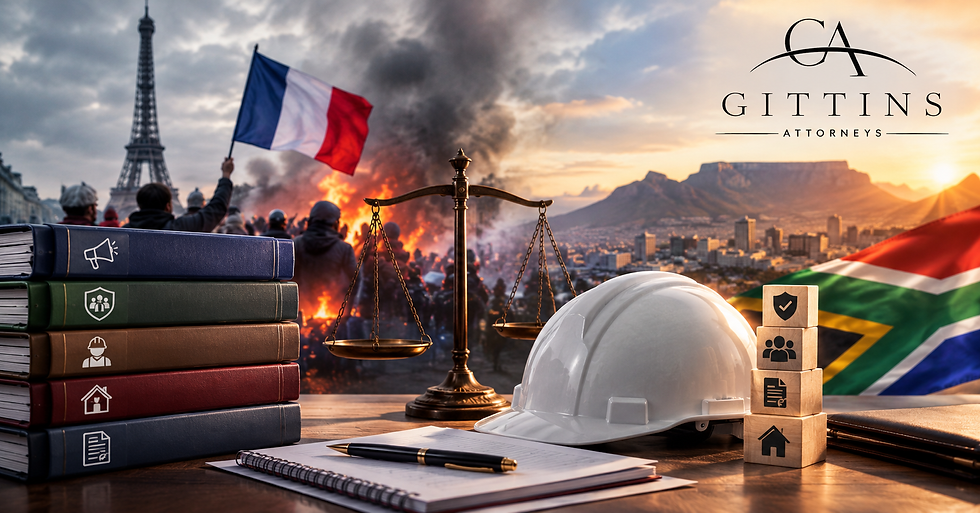
France is currently in the grip of its worst unrest in years. On 17 October 2026, an estimated 550 000 people marched across the country. Demonstrations about the cost of living, fuel prices and education funding were largely peaceful at first, then turned into looting and arson, and reportedly left one police officer and one protester dead. By 19 October, Paris police had banned gatherings and imposed a curfew in parts of the capital, and the Prime Minister had not ruled out a state of emergency.
For South African readers this is more than foreign news. The questions France now faces are ones our own courts, police and businesses have confronted: where does the right to protest end, what powers may the State use to restore order, and who bears the loss when a protest turns violent? This article summarises what has happened and compares the French response with the South African legal position.
How the protests unfolded
The movement began with students. From 18 September 2026, high school students started blockading schools over overcrowded classrooms, teacher shortages and inequality. University students joined on 1 October, and by 5 October between 400 and 500 schools were partly or fully closed. It was reported that 24 schools had been burned or ransacked.
On 6 October the protests became a nationwide mobilisation of students, teachers, parents and trade unions. Prime Minister Sébastien Lecornu instructed his ministers to address the students' main demands and to present initial proposals by the end of October.
The movement widened on 17 October, when trade unions, including the CGT, and the Yellow Vests movement called a national day of action against the cost of living. Students, teachers, firefighters, farmers and climate activists joined. The Interior Ministry put turnout at about 550 000 nationwide, including 110 000 in Paris. The Prime Minister said 1 200 people were arrested that day and 150 police officers were injured. Justice Minister Gérald Darmanin later said more than 2 330 people were taken into custody over the weekend. Protesters set fire to the town hall in Limoges, and in Marseille dozens of shops were looted and a group broke into the city hall.
The government’s legal response
President Emmanuel Macron addressed the nation on 18 October. He condemned the violence, promised that rioters and looters would be prosecuted, and drew a line between protesters with legitimate demands and those who destroyed and looted. He stopped short of declaring a state of emergency or a national curfew. Instead, he said prefects and mayors would be allowed to ban certain gatherings to protect public buildings and businesses. He also ordered a review of whether there were failures in intelligence gathering or police preparedness, and asked the government to bring together students, teachers, lawmakers, unions and business leaders to produce concrete proposals.
Local measures followed within a day. Paris police issued orders banning gatherings and demonstrations, and imposing a curfew, around the Place de la République and the Les Halles shopping district. The Prime Minister said the government was ready to impose a state of emergency if needed, and the interior minister said the police had lost control during the weekend, despite some 60 000 officers being deployed on the Saturday.
A state of emergency is a significant step in France. It rests on a 1955 statute and lets the executive impose curfews, restrict movement and conduct searches without prior judicial approval. It was used in the 2005 riots, when regional officials gained power to impose curfews on minors and search homes, and again from 2015 to 2017 after the Paris attacks. The government also considered, but did not declare, one during the Yellow Vests protests in December 2018. The present debate is therefore a familiar one: how far the executive may go in restricting freedoms before a court or parliament has a say.
Policing and the use of force
The unrest has also put the police under scrutiny. According to Interior Ministry figures released on 13 October, France's police inspectorate had opened 36 investigations into alleged police violence since the high school protests began. Human Rights Watch reported that a 15-year-old lost a hand to a police stun grenade and a 14-year-old suffered a shattered jaw after being struck by a tear gas canister fired at close range. These are allegations, and they have not been tested in court.
The legal test is the same in most democracies. Force must be necessary, proportionate and a last resort, and those who use it must be accountable. France is bound by the European Convention on Human Rights, which protects freedom of assembly, and by the International Covenant on Civil and Political Rights. The UN Basic Principles on the Use of Force and Firearms by Law Enforcement Officials set the international benchmark for crowd control. Whether France's investigations and any prosecutions meet that standard will be closely watched.
The South African position
South African law starts from a strong constitutional guarantee. Section 17 of the Constitution of the Republic of South Africa, 1996 protects the right of everyone, peacefully and unarmed, to assemble, demonstrate, picket and present petitions. The Regulation of Gatherings Act 205 of 1993 gives that right practical form. Organisers of a gathering must generally give the local authority notice in advance. The Constitutional Court held in Mlungwana and Others v The State and Others [2018] ZACC 45 that criminalising a failure to give notice was unconstitutional, because it unjustifiably limited the right.
The Act also deals with the consequences of violence. Section 11 makes organisers and the organisations behind a gathering liable for riot damage, subject to defences that turn largely on whether they took reasonable steps to prevent it. The Constitutional Court dealt with this in South African Transport and Allied Workers Union v Garvis 2012 (6) SA 882 (CC).
On policing, our starting point is the same as France's in that force must be necessary and proportionate. The 2012 Marikana tragedy and the Farlam Commission that followed remain the cautionary example for South African crowd management.
On policing, our starting point is the same as France's: force must be necessary and proportionate. The 2012 Marikana tragedy and the Farlam Commission that followed remain the cautionary example for South African crowd management.
The most striking difference is the state of emergency. Under section 37 of the Constitution, a state of emergency may be declared only by an Act of Parliament, and only when the life of the nation is threatened by war, invasion, general insurrection, disorder, natural disaster or another public emergency, and the declaration is necessary to restore peace and order. It lapses after 21 days unless the National Assembly extends it, and each extension is limited to three months. The Bill of Rights may be limited only to the extent strictly required, and certain rights cannot be limited at all. In the July 2021 unrest in KwaZulu-Natal and Gauteng, the government did not use section 37 and deployed the South African National Defence Force instead. In both countries the legislature decides whether an emergency continues. In South Africa, though, the limits are written into the Constitution itself, including a list of rights that cannot be limited.
Practical lessons for South African clients
The French events carry practical points for our clients, whatever their size. Organisers should give notice under the Regulation of Gatherings Act, appoint marshals, record the steps taken to keep the gathering peaceful, and keep those records. They are the main evidence of the reasonable-steps defence if riot damage is claimed. For employers, a worker's participation in a protest is not automatically protected. Protest action to promote or defend workers' socio-economic interests must comply with section 77 of the Labour Relations Act 66 of 1995, including prior notice. Employers should have a clear policy on absence, safety and unprotected action before the next march.
Property owners, landlords, and body corporates should check what your insurance covers. Standard commercial policies commonly exclude riot, strike and civil commotion. Review force majeure clauses in leases and service contracts at the same time. The common thread is preparation. The cost of an unrest usually falls on those who did not plan for it.
Conclusion
France's unrest is still developing, and the next steps are the proposals the government has promised by the end of October and any decision on a state of emergency. What it already shows is how quickly a lawful protest can become a public order crisis, and how quickly the debate turns to the limits on emergency powers. South Africa's constitutional framework sets those limits in advance. Organisers, employers, property owners and insurers would do well to plan with the same care.


Comments